Showing posts with label Teaching. Show all posts

Thursday, May 2, 2013

Reaping One Last Seed

I received a surprising email about a month ago from the Ohio FFA Association inviting me to attend a retiring State FFA Officer reunion in May 2, 2013 as Kayla Starlin's former FFA Advisor.  It was such a pleasant surprise as I hadn't taught at Logan since 2010.  It was so thoughtful of Kayla to include me in her special weekend.

I have taught some truly remarkable students over the years.  I thoroughly enjoy every letter, card, email, phone call, facebook message and tweet keeping me updated on their accomplishments and sometime disappointments.  Selfishly it is nice to be remembered and included in your lives.  Thank you all for keeping me in the loop.

As I sat in the audience at the State FFA Convention today with a mother of one of my former students, she was reminding and pointing out all of the outstanding students I have had the privilege to teach over the years. There have been outstanding leaders and many good souls. They are too numerous to count. It has been a blessing.

Included in this picture with me is my former teaching partner Andrew Delong, Kayla and my former student and current Agriculture Education teacher with Andrew, Jeremy Grove.  

 
Kayla I couldn't be more proud to have been able to be your teacher and advisor. I hope you enjoy a fantastic convention and  I look forward to all of your wonderful accomplishments yet to come.

Friday, March 15, 2013

Ohio Beef Expo - Beef Checkoff

I abandoned Jake today to fulfill a duty as a beef producer and Ohio Cattlemen Board member to attend the Ohio Beef Expo.  He had to pick up my slack. (sarcasm).

I decided to attend not to see all the competitive shows, new products to make the cattlemen's lives easier and not even to socialize with all the beef producers.  The real reason I went is to help collect signatures for the checkoff dollar referendum.

There seems to be confusion in Ohio about what the Ohio Beef Council needs more money for. The Beef Council uses checkoff dollars to promote our product and educate our consumers about preparing, cooking, storing and sharing our beef.  Right now this service costs you $1.00 per animal sold.  Half of this money is sent to the National for them to promote beef across the country.  Many states send more funds to the National to promote our product in places with more people than cattle like New York City or LA.  Since about 1986 we have been promoting our product with their help with just $1.00.  These people promoting on our behalf, I believe have done an outstanding job doing this.

The number one reason I believe a checkoff is needed in Ohio is because we need to be promoting beef in high school classrooms.  High school students are sent messages geared toward a youthful crowd, many of which encourage vegetarian diets to Teens.

The best way to talk to high school students about what beef has to offer them nutritionally, how to prepare it and where it comes from is to develop a program to take to high schools.  Of course you would have to train producers to facilitate the program.  The pork people have already done this.  However the Ohio Beef Council received a grant to create and share the Beefonomics Program.
When you start to break down the numbers to promote beef in the high school classroom they look like this.

In 1986 we could have promoted beef in a high school setting by sending producers and paying their mileage, of course gas was $.89.  We could have sent them with beef to teach the students to prepare and cook properly and it would have cost the Beef Council $2.29 per pound.  We could have rested knowing that many students were not receiving advertisement from HSUS and PETA. But we didn't, we didn't have the Beefonomics Program.

We do now have a grant funded program to take to the classroom.  It was developed about three years ago, however since we don't pay our beef promotions manager enough money, we are now on our third individual taking on this task of launching the program.  On top of this it is now 2013 where gas now costs $3.26 and beef costs about $5.02 per pound.

I had the opportunity to present this program to two classrooms where high school students had questions about cutting steaks and how to cook them.  The teacher told me she really didn't like to eat beef, because her mom overcooked every piece of beef she ever ate as a child.  She told me as I left she intended to take the recipe home we had cooked in class to share with her family.  Beef was now back in her classroom and her home.  I thought that was worth the beef checkoff dollars used.


Friday, December 14, 2012

BEEFonomics

I spent the day promoting beef with the BEEFonomics program on behalf of the Ohio Beef Council in Lancaster, Ohio. I had two wonderful partners Connie Smith and Tiffanie Baker. Connie works with extension and is very active through the Fairfield County Cattlemen along with being a beef producer.  Tiffanie is one of my former students and an Animal Science major at the University of Findlay.

The program visually describes the bovine timeline taking students from conception to the plate.  We mention many of the environmental and animal health standards we work to achieve.  We also talk about food safety, optimal cooking and storing beef temperatures, and the nutritional value of beef. It ends with the cooking of beef stir fry.


One of the best things about sharing this information with the teacher and students is the feedback you receive about the program. Some of the things making that list this time are:

1. That Beef provides ZIP to your diet. ZIP stands for Zinc, Iron and Protein. It is unlikely to get the same amount of ZIP in your diet through other foods.

2. The participants found it unbelievable that it takes 2 years from the conception of a cow to get that calf to your plate.  Which is why, it was so disappointing when going to lunch with some of my friends at a steak restaurant the other day when they burnt my burger.  It took us 2 years to get him/her the hamburger and approximately 20 minutes for them to char it to a inedible crisp.

3. Several people raised their hands when asked if they thaw their meat in the sink.  I firmly told them that they should stop doing that immediately. Bacteria love to grow at room temperature. Gross.

4. The final topic that was found interesting, is our slide and discussion about the different cuts of meat and the proper cooking techniques for each.

5. We also had some great conversation about the effect of the drought on the beef industry.  We even talked about the labels found on the beef at your local grocery.

The teacher was inspired, with 29 lean cuts of beef slide and handout.  She mentioned she was going to Applebees tonight and was asking questions about the flat iron.  I think she may order it.

I squeezed in on behalf of the USFRA the handouts about logging on to food dialogues and voting for the next faces of farming and ranching, while we were cooking the stir fry. I couldn't resist.

I would like to send a big THANK YOU to all of the beef producers in Ohio who either graciously or reluctantly pay their check off dollars. Although a majority of this program is being funded through grants, at some point the Ohio Beef Checkoff will need to support and grow this program, bringing practical knowledge to students and continuing to help grow the beef demand.


Wednesday, December 12, 2012

Science not Politics

If you would like to change the world, an education and career in science should be your route not politics.  I am told there was a time in our country that our representatives in politics actually had businesses and careers in their hometowns and only went to DC or their respective State Capitols to discuss and vote on official business. Hmmmm!

I see a lot of people commenting, blogging, reporting, and voting on things they are not entirely educated on.  If you want to change agriculture, food sources, education, medical practices, laws or anything else your heart desires, you should be studying the subject matter through a multitude of resources (including live people interviews) and do some old fashioned science projects. This should be a top priority.

There are many issues this applies to, some from my former classroom teacher days, some from owning a feed yard and some from my community of agriculture people I pal around with.

Who thought it would be a good idea to make it more of the responsibility of teachers for the attendance, graduation and passing of "the test"?  Who thinks that high school students who are days from entering the real world, where we want them to get out of bed and get to a job where they will pay taxes, are given no responsibility in setting an alarm and getting themselves out of bed? Many times in my teaching career I was told to call parents of 17 and 18 year old students' about them being late, not turning into their homework, and not working to their potential. I think a good talk with the pre-adult student would be more useful.

We coddle children in our society entirely too much, always thinking we expect too much of them. Then one day we want them to wake up and be adults. Who would think that is going to work?  I often look to the Amish Community when thinking about expectations for our girls.  If I grade myself on this scale I would be failing currently as an Amish Mom. My girls don't do laundry, have any real cleaning responsibilities, bake or cook.

The most recent story being talked about is antibiotics being used in livestock.  I understand the concern for the topic, however I can't understand why after all these years someone would go to the government rather than the laboratory/feed yard/farm to see if those people are concerned.  I surround myself with some really smart people. It is part of my plan to get through life. Dr Francis Fluharty is just one of those people. He has spent his life studying chemistry, animal science, and ruminants and in my mind if he says it's safe and he feeds a lot of beef to his family, I believe him.  Can you believe with all of the uproar over antibiotic use, not one person has called our feed yard. Not one reporter trying to get the truth, not one editor determined to find the truth for their readers.  Don't you think asking a feed yard owner about antibiotic use is important? Don't you think asking, "what if, we told you tomorrow you can't use any antibiotics at 4+ Feeders, what would you do?" "What do you think would be the repercussions to the consumer and how many cattle would suffer or worse die?"

If I was a reporter, I would ask these questions:

1. If antibiotics were not able to be used, starting tomorrow, what would happen at your feed yard?
2. Would the price of beef go up, if so in what proportion?
3. What things do you do to use less antibiotics?
4. When you choose a steer/heifer to butcher for your family, do you make sure you get one that has not been treated?
5. How do you choose a steer/heifer for your family?

The problem with our thought patterns is we have become a nation of couch problem solvers.  If we have an issue, problem or complaint we should not always email our representative.  We should first write people that have first hand experience with the "situation". We should also find people to represent us in government that have had at least 10 years of experience in the field.  For example before you start telling people how to run a classroom and what is best for their students, you should have been in a classroom teaching students.  That does not count, being in a principals office. Because unless you are in the trenches, it doesn't count.

Monday, December 10, 2012

The technology of Record Keeping.

I was recently asked to make comments on an important Agriculture Topic. What has been the best new technology or management style that farmers and ranchers use to produce more food?

One of the oldest and most effective management quotes on record is "you can't manage what you don't measure".  Farmers and ranchers continue to get new technologies in order to record and measure more and more information.  As we continue to collect and record more data we are able to manage more intensely. Examples of these include the use of EID (electronic identification) tags and the collection of this information.  At 4+ Feeders we are able to document the antibiotic given, date given, and withdraw date.  Being a backgrounder for calves that eventually move to another feed yard, this information easily transfers to the next care takers of the cattle.  In return beef consumers can be sure that their steaks, burgers, brisket or roast are completely safe.

There are numerous devices and tools that have been designed to help with food production.  I am sure you are thinking about a few right now.  However when I was teaching Agriculture Education I told all of my students whether they were returning to the farm or not that keeping track of expenses and expenditures for personal use, or if they were running a hair salon, dairy or any other business keeping accurate records is extremely important.  We filled out mock record books in class.  I recognized that the curriculum has called for all information to be put into a computer system.  I think it is extremely important to keep records electronically because it will give you more data and information to make better business decisions.  

However I always felt as a teacher to students being introduced to record keeping, that they should do their own adding and subtracting.  I didn't like the computer system adding for them and transferring the numbers through the book and then subtracting the expenses and telling them what they made.  I wanted them to understand the numbers moving through the system and how to change them.  It was important for them to understand that profit could be increased by both decreasing expenses and increasing income.  

I will never forget the day I realized that America was at a great loss in our education system for not teaching this anywhere in math except as an elective.  I had a National Honor Society student in my class and at the end of the week of teaching these concepts, he said "I am in Honors Algebra II, and I just don't get this."   I am thinking at this point and we are in big trouble. While I appreciate the math I have taken involving letters, that math has not made me near the money that math with numbers has.  

I am so thankful for the record keeping experience Jake and I have had with the FFA and Agriculture Education. If it wasn't for that experience, we wouldn't be doing what we are today.  Although our record system has changed and continues to evolve based on the information we want to collect and need to collect.  

There are two things that reminded me this weekend about how important record keeping was and continues to be in all facets of life.  The first was my cousin Friday night sitting down after we ate dinner together to count and record the money she had made cutting and coloring hair that day.  She recorded information from that day on paper, quite possibly the most simple record keeping system available, but still very useful. The second thing was when I found my Grandpa's record books from his Agriculture Education and FFA days.  I wish I would have had these when I was teaching.  These are my Grandpa Jim Poorman's record books from his Junior year of High School in 1942-1943.  This was the same year that he quit high school to take over the family farm after his father passed away. 


According to his records he took corn, wheat, cattle, sheep and hogs as his projects.  

This is an agreement that is very similar to the one found in today's record keeping system for Agriculture Education. It always bothered me that students would forge their parent's signature on these.  I would tell them it was against the law to sign someone else's name, they would say "oh my parents don't care".  Do you think these signatures look like forgeries?

Isn't this budget interesting?

A cattle Plan of Practice. In 1942 it looks like corn was on the menu for cattle.  Hmmmm!


Does anybody want to harvest corn with this plan of practice?
  

Thursday, November 1, 2012

What do middle school students need to know about Agriculture?

I spent the morning at mass for All Saints Day. It was Jaelin's Kindergarden's class first mass.  I thought they did an exceptional job behaving themselves.

I then spent an hour this afternoon with the seventh and eighth graders at St. Mary's School, who will be future meal time decision makers.  We had great discussions about where there food comes from.  Most of the students are non-farm kids and I was able to get some of my questions answered too.  In conversation I asked if any of them had seen the Chipotle advertisements about pork production.  After several strange looks, they said we have no idea what your talking about.  SCORE one for the farmers.

We only had an hour, we covered a lot of information.  They asked some good questions like, they wanted to know the difference between ground chuck and ground round.  We talked about animal behavior, the chain of events cattle go through to get to their plate, Temple Grandin, job opportunities within the Agriculture Industry and ended talking about how the world needs all kinds of minds. I was invited back and we will be discussing some issues and hot topics in Agriculture.  Please send me ideas and websites for what you think is important for what seventh and eighth graders need to know about their food choices.  This may become a research project for them. Talking with the youth of America about real life topics is inspiring, awakening, educational and is highly recommended.


Thursday, July 12, 2012

What to do when the electric is out.

When you have younger kids, the first thing you do is establish three or four times which things they can't do because they require electric.  The second thing you do is try to get them to understand that a generator can't run everything and while Disney and Doc Mcstuffins are very important, they do not trump a deep freezer full of beef.  With those things established we moved on to finding things we could do without electricity, which became a form of challenging fun.

We first had a puzzle marathon and labeled boxes that had missing pieces, so if we ever find them we will have a good idea of where they go.  I should note the reason we have missing pieces is because the girls ran a zoo or dog shelter I am not sure which in their rooms for awhile and they used the puzzle pieces for food. I am sure I will think that is funny also someday.  I also realize I should have put the puzzles along with many other items on a higher shelf.

By the second day with the generator underway and it looking to be days before electric would be restored and all of the puzzles finished we moved to project two.  The Blossers bought Jacie a sewing kit and small machine for her birthday last winter.  With no electric I thought it to be the perfect time to get the material out and help Jacie cut out her first quilt.  I cut with a rotary cutter and mat - hmmm.  That would not work for Jacie.  Jacie also does not measure well enough to mark the squares.  Oh and then I remember Grandma would use a piece of cardboard for a pattern.  That is actually how I cut the quilt out Grandma "helped" me with.  I cut a pattern and she was on her way.

I was thinking - this is painful, why did I start this, why didn't I purchase a bundle of fat squares.  Over a process of several days they were cut out.  The work was done 70% by Jacie, so I would give her a C on cutting.  But, for a seven year old I probably should not be criticizing. Then she laid it all out in the pattern she wanted in the middle of the living room floor.

She was then bored, so she left to go do something else.  Her dad came home and turned on the fan and well you know what happened.

I don't know if it is her age or the generation but they want a one minute craft with stickers and paper.  She wants to start a project and for it to be finished in one minute.  I really hope that sewing teaches her patience.


Tonight she decided she wanted to sew.  She sat down at the machine with 100 questions of how she could get hurt because she is cautious like that.  You would have thought it was a table saw or a gun.  Since her pattern was gone, I just had her sew pieces together in a random order until she finished two rows. Then she was bored and I needed to clean up supper so the other seven rows will be finished another time.

That is the status of her quilt thus far.  She wants to enter it in the Belmont County Fair in September.  I have a feeling it will be finished and featured on this blog in 2026.

Saturday, July 7, 2012

Found some stuff . . .

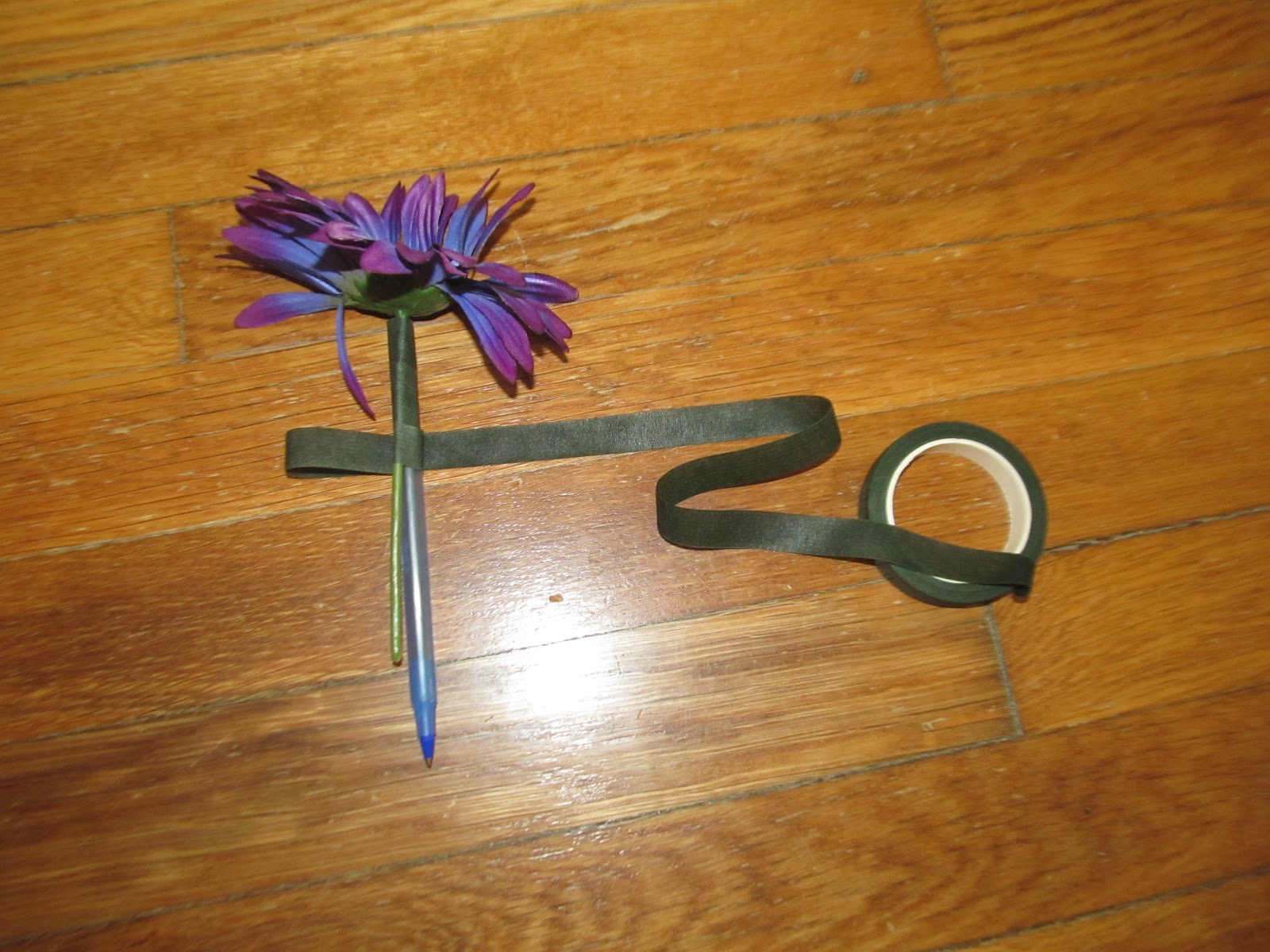
I have been cleaning unwanted boxes out.  This is a true feel good experience.  If you need a pick me up - clean out a box or a drawer.  Since we didn't have electric, I started cleaning.  A few years back I thought it would be fun to figure out the Floriculture CDE and we did over a period of a few years.  We progressively moved from around 10th to 2nd in the state. In the process I learned some skills.  I can now make corsages, bows and flower pens.

I found this left over stuff I had purchased for my cousins bridal shower these were the center pieces and then each guest left with a pen. After cleaning out the box and finding these things and still not having any electric I thought I think I'll make them.
If you want to make them, this is what you will need . . .

flowers of your choice . . .

floral tape and pens . . .

First take each pen and discard the cap. Next hold the flower next to the pen so the flower covers the top of the pen.  Next use the tape to cover the flower and the pen.  If you haven't used floral tape before it is sticky but will not dry that way.  If you slightly stretch the floral tape and wrap it around the object it will make a smooth appearance.

 I cover each pen almost down to the end of the pen.

Finally find something beautiful to display your pens in.  I believe the cost of the pens were roughly 50 cents, mostly because I bought nothing on sale or with a coupon.

These would make an excellent gift for a teacher.  I used to have a set for my desk for students to borrow.  It worked out nicely, boys suddenly started remembering their own writing utensils and these rarely left the room.

Wednesday, May 9, 2012

Beefonomics

I volunteered to help roll out the new Beefonomics class designed by the Ohio Beef Council. This program would not be possible without the beef check off dollars. This program is geared towards Family and Consumer Science Classes in local high schools.  This information is being presented to future mealtime decision makers.

Yesterday Jaelin and I went to Krogers to find the ingredients for the recipe we would be making.  This was only the second time I've ever purchased beef at the grocery store.  It was enlightening as I was introduced to the problems many mom's may have when choosing a beef cut.  I was looking for top sirloin steak.  As I was browsing the meat case, Jaelin was moving the large "car cart" that she talked me into pushing around.  I hate that cart with a passion.  It is enormous and it does not move very well.  By this time, Jaelin is out of the cart moving it around and hitting the meat case and almost an older woman.  I was becoming frustrated.  I am now thinking a working mom after work with her hungry kids, just gave up on our product. I do believe the labels on how to cook the meat were very helpful and kudos to whoever designed them and for the beef check off dollars for supporting them.  The labels however still were not helping me find the top sirloin steak.  I finally just asked the woman who was placing meat into the case.  I was pleasantly surprised by how helpful she was. She found me the top sirloin steak, and then she even answered my questions about a substitute for the steak I was choosing.  *Note to self and others - When shopping with kids just ask the butcher to help you find the cut for the recipe you want to make your family. 

Today Andy Johnson from the Ohio Beef Council came and met me at Union Local High School to help me with my first Beefonomics lesson.  It went well.  Andy designed a power point presentation  that explains how long it takes to get beef to the plate, what beef producers do for the environment, economics, what nutrition aspects it brings to your body, what lean cuts beef offers, how to cook beef properly and how to handle it safely.  In addition to all of that we also cooked a stir fry.  It was a lot of information in a short period of time.  It led to great conversation and I had a great time sharing our beef story with both fellow beef producers and to high school students who just enjoy eating beef. We left the students with a challenge to create a video, using the rubric to pick a recipe and take us through the process of choosing the beef cut to enjoying it with their friends and family.  Prizes will be awarded and videos will be linked to the Beef Council Website. I am excited to see what is shared.


If you are interested in learning more about the Ohio Beef Council or Beefonomics - http://www.ohiobeef.org/


Friday, May 4, 2012

Court

I have on occasion enjoyed a good court show on television.  I always in the back of my mind wonder how much of it is true.  I was subbing today at the local high school and immediately during first period, a student says we are outa hear in just a few minutes.  I said, really where are we going. He said, there was court in the auditorium and not like mock trial.  This was the real thing.  I was wondering how this would work.  Soon the announcement came on and we went to the auditorium.  On the stage was the judge and his clerk.  In the front row was a group of prisoners, in orange jump suits.  There was also 3 deputies.  I am thinking this is awesome!

The judge soon said this is now a court room, he firmly told an adult in the front to put their newspaper away.  He said I run a tight ship and there is no newspapers and no drinks.  He went on to say if you talk during court and you are above 18 you will be handcuffed and taken to jail and if you are under 18 you go to the juvenile detention center.  I am thinking, wouldn't it be nice if teachers had the same privileges.  He stopped court to explain different things.  The judge takes his court once a year to every high school in the county.  What a great experience?

He called case after case.  I won't share all of them with you, because some of them I don't remember.  However I will share some of the details worth remembering.


He calls a girl to the stand that has been in jail for what she says is four days.  The deputy said it was two.  The judge asked her again and she said she can't remember how many days she had been in jail.  (I know, I am thinking the same thing!)  He asked her why she had missed the second opportunity for community service and she said she doesn't remember having the first opportunity.  The case was this, she was arrested for theft, he gave her community service, she didn't show up.  She had to come back to court, he said against his better judgement he rescheduled her community service.  She didn't show up again, they put a warrant out for her arrest, she gets hauled to jail.  She is now in court.  He put her back in jail.

A man who was picked up drinking and driving on a motorcycle, who was also dressed in an orange jump suit was up next.  He was accompanied by a sister, aunt, cousin or something.  (I didn't know you could bring someone with you.) He pleaded not guilty, meaning he would get another court date. They also needed to determine if he could pay for his own attorney.  So the judge asked if he worked. He said oh yeah I am a coal miner.  The teacher next to me whispered, not anymore.  The judge said, great you can get your own lawyer.  He said he would.  The girl with him then asked for permission to speak.  She asked about getting the motorcycle out of impound.  The judge said that according to Ohio law after your third Driving Under the Influence the state impounds your car and sells it for the benefit of the state.  I did not know that!

The judge stopped to explain how hard it is to get your license back from the state, leading to driving under suspension charges.  He also explained insurance issues.  It was great - and I think more high school should do it.

Friday, April 27, 2012

They let me sub again!

I have been subbing for the local high school.  They call me when the Industrial Arts teacher or Agriculture Education teacher are going to be out and I get to pretend to be a teacher.  I highly recommend if you have a few days here in there you sign up to substitute at your local high school.  The pay is terrible, but the education is valuable.  Depending on what is going on in their lesson plan, they sometimes allow me to make my own lesson plan.  I love making one day units to teach something I deem important to high school students and future tax paying citizens.
Today I was teaching and I decided that I wanted to ask the sophomores and seniors about entitlement. The idea that today we believe we are entitled to things that a couple of decades ago people didn't feel that way about. I asked them to take one piece of paper and fold it in half long ways.  Then I asked them to make two columns one listing what you deserve if you are "working" and one column for things you deserve if you are "not working".  We did not define working or not working.  These were the responses from the 16 students who participated.  What do you think?


“WORKING”                                                                          “NOT WORKING”

House- 7                                                                                  Shelter- 4
Nice House- 1                                                                          House
            Shower                                                                        Low end housing
            Bed                                                                              Bed
Food – 5                                                                                  Food- 4
3 Meals a Day- 7                                                                     3 meals - 4
Clothes -1                                                                                2 meals- 2
Nice Clothes – 2                                                                      1-2 meals - 1
Clean Clothes                                                                           1 meal - 1
Job Security                                                                             water
Tax Relief                                                                                 clothes - 3
Good Pay- 1                                                                            used clothes - 1
Paid                                                                                         Welfare
Pay Check on time                                                                   a hug
Medical and Dental Insurance
Medical Insurance- 2                                                                medical insurance
Minimum Salary- 1                                                                   unemployment- 1
Paid Benefits- 1                                                                        help if needed
Money- 3                                                                                 a job- 1
Suitable working conditions                                                       spending money
Working Tools
Working Apparal
Drivers License

Extra Rights and Privileges- 2                                                     less privileges
Luxuries                                                                                   no electric
Cell Phone
Credit Card
Rights and Privileges to drink
Sleep                                                                                        Sleep
Car- 10                                                                                    Car- 1
Guns
Kids
Animals- 5                                                                                no animals
Marriage- 1
Land
Medicine                                                                                  medicine
Friends                                                                                    friends
Doctor                                                                                     doctor
Toys (ie 4wheeler)- 3
Television
Respect- 1                                                                               respect- 1
Radio
XBox


* the numbers indicate how many students reported that answer

Now what to do with this information!  I am deciding if I should do a follow up next week when they let me go back.  What should the follow up be? What are we entitled to as Americans?